
Fishing boat and birds off the coast of Montauk.
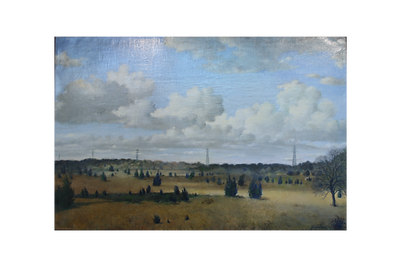
Ralph Carpentier, Cedars North of Amagansett, 2008, 29 x 44
An exhibition in the East Hampton Marine Museum.
BIOGRAPHICAL ARTICLES
Ralph Carpentier: Painting Again, In Pain And Hope
by Patsy Southgate, The East Hampton Star.
4 January 1996.
Reprinted by permission of The East Hampton Star.
Name Change
Mr. Carpentier was born in 1929 in St. Albans, Queens, a big step up from Manhattan, he said, for his Italy-educated, immigrant father and his Italian-American mother. His father was a printer who became a proofreader for The New York Times.
His grandfather, the artist explained, was adopted by a Frenchman named Carpentier who brought him up in Italy, Italianizing the name to “Carpentieri.” His mother changed it back again, in their German-Irish neighborhood in Queens, to protect her children from the stigma of being “the only guinea kids on the block.”
“But I feel like an Italian-American,” Mr. Carpentier said. “I ate the food and spoke the language; it’s my heritage.”
Growing up, Mr. Carpentier wanted to be an artist while his parents advocated a profession; they compromised on a major in book illustration at the School of Industrial Arts. “I became a compulsive drawer,” he said, “drawing four and five hours a day, on the subway, in the park, fooling around in coffee shops.”
Commercial Fisherman
After graduating from New York University in 1951 with a degree in education, Mr. Carpentier served in the Army during the Korean War as an occupational therapist. He was stationed in Hawaii, working with amputees and psychiatric patients. “All the skills I had learned preparatory to teaching art were applied to healing,” he said.
Upon discharge he returned to N.Y.U. for an M.A., and moved to the East End in 1955, landing a teaching job at East Hampton High School. In the years that followed, the artist supported himself with a variety of jobs as a teacher and art instructor at Guild Hall, the Museum of Modern Art, N.Y.U., Southampton College, the Hampton Day School, and the Art Barge on Napeague, and worked as a book illustrator and set designer.
Mr. Carpentier also tried his hand at commercial fishing, from 1959 to 1962, working on draggers and haul-seining and gill-netting with the late Jimmy Reutershan and other baymen. “I loved it, but you have to be obsessed to make a living at it,” he said.
In 1960, he married his present wife, Hortense, a psychotherapist, and built their house and studio. (A first marriage ended in divorce but presented him with a daughter, Martha, and, recently, a grandson.) In 1981, he became executive director of the East Hampton Historical Society and director and curator of marine history at the East Hampton Town Marine Museum. He was an officer of the East Hampton Town Baymen’s Association in 1984.
A video produced last year in an LTV series called “Let’s Talk About Art” records the evolution of a Ralph Carpentier landscape painting from preliminary sketch to finished work of art.
We see him drive his pickup down Atlantic Avenue toward the beach in Amagansett and park it at the site: a little hill behind the boarded-up Beach Hut, with a view of coastal dunes.
He props his sketch pad on the truck’s hood and, with his left hand, begins to draw: quick, nervous pencil strokes, faster than the eye can follow. A hilly horizon animated by a line of trees and buildings takes form, blobs of stubby cedars dotting the foreground, the sky a vaporous emptiness above.
Cedars and Clouds
Cut to the artist’s studio in Springs. Mr. Carpentier confronts a large blank canvas. With a measuring tape, he establishes a low horizon line and charcoals in the site’s trees and buildings.
The left hand moves deliberately now, his right hand wiping away mistakes with a rag. The little dabs of cedars re-emerge and are rearranged. Cumulus clouds roil across the sky, are rubbed out, and reappear.
Then, abruptly, Mr. Carpentier wipes the entire drawing from the canvas. “There is too much action,” he says, and starts over. After several more attempts he is satisfied and traces his drawing in pencil, rubbing away the charcoal that would contaminate the paint, leaving a ghostly outline.
Metaphmorphoses
“Now the fight really begins,” he says, “doing battle with color and form to get them to cooperate.” With swift, jagged brushstrokes his left hand blocks in colors: the bitter yellow of winter dune grass, the blackish-green of cedars.
The tape, in a series of silent freeze-frames, now records the painting’s final metamorphoses: fleecy clouds in a blue sky, then towering storm clouds, a tranquil silver haze, and finally, the palest turquoise sky, a band of dainty lavender clouds hovering just above the horizon.
“Name and date, the work is finished,” Mr. Carpentier says. “By that I mean I don’t know what else to do to make it better. Sometimes reaching that point takes years.” The tape was made over a year ago, before open-heart surgery in early September cost the artist the use of his painting hand.
Quadruple Bypass
Ten years ago, Mr. Carpentier underwent two angioplasties to unblock clogged coronary arteries. When he experienced chest pains again last summer, he said recently, an angiogram revealed he was “a walking time bomb for a heart attack,” and quadruple-bypass surgery was performed.
Before embarking on the operation, he had the foresight to stretch some canvases. “I planned to recuperate by painting,” he said, “hoping to escape the post-surgery depression and boredom that most people go through.”
In the recovery room, however, Mr. Carpentier became aware of acute pain in his left hand. “I was told it would be okay in six weeks, but after three months, there was still no relief,” he said. “I couldn’t paint, or sleep; my recuperation plans were totally screwed up.”
Painting Hand Atrophied
The painkillers prescribed for him were ineffective, he said. The ulnar nerve had been damaged. The pain persisted, and the hand atrophied. He couldn’t even draw with it propped on a mahlstick, a cushioned handrest used by Renaissance artists to achieve exactitude.
“For a realistic painter, it was like being in hell,” he said. “I got very depressed, and acted out my nightmares in bizarre, manic behavior.”
A visit last month to the Mayo Clinic helped stabilize his blood sugar, a persistent problem since Mr. Carpentier is a diabetic, while treatment with Neil Cash, an occupational therapist at Southampton Hospital, set him on the slow road to recovering the use of his left hand.
“Neil devised a prosthesis so I could work,” Mr. Carpentier said. “An elastic glove with the ‘good’ fingers cut off, fitted with a plastic form shaped to the heel of my hand, takes the weight off my pinkie and reduces the pain to a dull ache that allows me to do quite a lot of drawing at a stretch.”
In the Dutch Tradition
Over the years Mr. Carpentier has exhibited and had one-man shows at many local galleries and museums, including the Parrish Museum, the Heckscher Museum, Southampton College, and Guild Hall. He is currently represented by Lizan-Tops Associates in East Hampton.
While trained in the Cubist tradition, in the late ‘60s, Mr. Carpentier began to grow uncomfortable with his painting style in relation to what he felt about the local landscape. “East Hampton is a flat place surrounded by water,” he wrote in a recent issue of The Conservationist magazine. “The overall mood is tranquil yet mysterious and inconsistent. I started to retrain myself to see this local landscape in a more intimate way.”
He began to make detailed, careful drawings of trees, buildings, and fields, much as he had in high school, eventually finding affinity and inspiration in 17th-century Dutch landscape painting. Haunting museums and poring over art books on the period, he watched his paintings emerge with the low horizons, big skies, and wide vistas of fields and dunes so beloved by the painters of the Ruisdael school.
Realist Style
“I had to teach myself to paint realistically,” Mr. Carpentier said, “but I felt comfortable and happy doing it. Other artists kidded me about my predicament recently, asking why I didn’t learn to draw with my right hand, or find another way to paint. I couldn’t find another way to paint if my life depended on it.”
“I like to draw out in the landscape and bring the drawing back to the studio,” he went on. “There’s too much information in a photograph, while a drawing contains my editing judgments and personal quirks, like deciding what to wear in the morning. The chances of dogs getting into the picture are much better than those of people, although sometimes I put in runners.”
“I’m a nervous wreck until I get all the color down,” the artist said. “Then the painting starts painting itself, and I can do the fun things like fixing up the trees, making elegant lines with my red sable brushes – or at least I could do that. I have to recover, and get on with a new body of work.”
All the “recuperation canvases,” as he calls them, that Mr. Carpentier stretched before his ordeal remain blank, except for one large one propped against a wall in his studio. On it, a charcoal horizon of trees and buildings can be discerned: the sketch of a farm in a Bridgehampton potato field.
“I was able to start working on that just a couple of days ago,” the artist said. “I still have a little more shifting around to do, but I think I can paint the painting. My hand will get tired, but I’ll struggle through.”
“The head is what makes people want to die, not the body. Now my head is okay. I feel hopeful at last.”

A plaque outside of the East Hampton Marine Museum.

View across the beach to the Beach Hut cafe.


The Victor D'Amico Institute of Art, or The Art Barge, on Napeague Meadow Road in Amagansett.

Field with an old barn in East Hampton.
A classroom with easels inside the Art Barge.
Ralph Carpentier, Beguiling the Viewer
by Robert Long, The East Hampton Star.
24 February 2000.
Reprinted by permission of The East Hampton Star.
“A picture starts talking back to you when it’s done,” the painter Ralph Carpentier said on a recent morning in the comfortable Springs house he shares with his wife Hortense, a psychotherapist.
“It takes a long time to get to that point,” he said. As he tells his students, “structuring a picture is arranging furniture, essentially. You want to get it perfectly poised. And then the picture starts talking back. The feeling that you get from it is really strong. It tells you when it’s done.”
Mr. Carpentier, a gifted landscape painter, has only in the last decade begun to achieve the kind of acclaim that all artists hope for, although his work has long attracted the admiration of his contemporaries, and of younger painters. His [then] dealer, the Lizan Tops Gallery in East Hampton, has had great success since it began showing his work in 1994.
Against the Tide
This might be attributed to a swing toward more modest acquisition on the part of collectors after years of hype that surrounded the hip painters of the 1980s – Eric Fischl, David Salle, and Julian Schnabel among them – and the high prices that went with them.
But Carpentier’s career has long been the story of someone swimming against the tide of popular taste.
“I’m in love with subject matter,” he said. “It’s the reason I paint it and the reason I try to hone my skills so I can paint it better. I’m not interested in finding some tricky, indentifiable Carpentier style.”
Some might argue, however, that there is just such a style – the vast skies filled with clouds, the low horizon, the seemingly inconsequential details: a woman no taller than two inches calling a dog home, three cows that sit placidly off to one side of the canvas in “Woodcutters’ Farm,” with its dramatic vista of fields and its huge sky.
Reminiscent of the Land
Weather is everywhere in a Carpentier picture; the natural world, as in Winslow Homer’s pictures, is sometimes welcoming, sometimes threatening, but always predictable.
But though the pictures present a convincing view of Long Island’s East End – its farms and fields, the landscape that we have seen vanish before our eyes for decades – they are not meant as documentary matter.
“I’m not commemorating landscape in that sense,” Mr. Carpentier said. “The truth is, if you were to take one of my paintings and bring it to the field it’s supposed to represent, you’ll find that the porch isn’t over here, it’s over there; the roof on this building is bigger than the roof on that building. I’ve manipulated everything because I’m working with abstract shapes to try to get a certain kind of harmony in the picture as your eye moves across it. Certainly it’s reminiscent of the place, though.”
An Early Inspiration
Mr. Carpentier was born in Queens on the day of the stock market crash, in 1929. His father had a new mortgage and a new child. Despite the hard times that followed, he managed to keep working at his trade as a printer or by repairing clocks and watches.
“He had to do something to earn money every day, and was really quite a driven man in that regard,” Mr. Carpentier said. “And that’s how I grew up – it was drummed into me that you have to be responsible to your family.”
Mr. Carpentier traces his interest in art to when he saw his first paintings by Corot, on a visit to the Frick collection, when he was a child. “I thought, ‘Gee, look at those pictures. Maybe I can do that,’” he said. “And that went hand in hand with being the talented kid in the family, the one who could draw and make things out of clay.”
Learning From Old Masters
The artist went to Andrew Jackson High School in Queens for one year, but “I started getting into trouble. I was a real juvenile delinquent.” He started skipping every class but art and eventually persuaded his parents that art school was where he belonged. “They got me into the School of the Industrial Arts up on 79th Street and Third Avenue. My whole life turned around,” he said.
In high school, Mr. Carpentier and his friends were trained to be book illustrators, “but mostly we learned by looking at Old Master drawings.” When he graduated, he wanted to go to the National Academy of Design to further study drawing, but his father insisted he go to college and become a teacher.
“So I went to New York University,” he said. “N.Y.U. at that time was making a complete turnover from a dreary academic art department to a hip, New York-oriented art department. It was a hangout for people like Barnett Newman, Franz Kline, Willem de Kooning. Tony Smith taught there. Bill Baziotes taught there. I ended up assisting Baziotes – he was a great guy and a wonderful painter.”
During Mr. Carpentier’s four years at the university, Jules Olitsky, Larry Rivers, Robert Goodnough, and George Segal were among his fellow students.
Married To Figurative Style
But in the course of finding a style, Mr. Carpentier found himself on the outside looking in at the trends of the time. “By and large, most of my generation, the prewar kids, were struggling to be second-generation Abstract Expressionists. Alfred Leslie, for example, was an enfant terrible then. He was all over the place. And a very good painter.”
“I admired Kline and Bill de Kooning, especially the way de Kooning handled paint. But you really had to have an inclination to do that stuff. I didn’t I was without a position because I felt that I was married to figurative painting.”
But Mr. Carpentier didn’t have time to dwell on aesthetic quandaries: he was drafted. Although the Korean War was raging in 1951, he was spared being sent to the front lines. Instead, he made prostheses for amputees and helped wounded soldiers learn how to use their damaged limbs in the course of their physical therapy.
Heading East
After he was discharged, Mr. Carpentier returned to N.Y.U., and, with the help of the G.I. Bill, earned a master of arts degree. He got a loft in Manhattan and searched for a teaching job.
“I worked at DeWitt Clinton High School in the Bronx for one semester,” he said. “It was a cesspool. And it had once been a prestigious high school, with famous alumni. The older teachers were very cynical. One told me, ‘Your job is to sit on the garbage can lid.’”
Although he had no problems with the students, Mr. Carpentier decided that Clinton was not for him. Continuing his job search, he found that the East Hampton School District was looking for an art teacher. “I got in my car and drove and drove and drove.” John Meeker, the School Superintendent, hired him.
Seeking Time to Paint
Five years later, he quit, got divorced, and began searching for jobs that would allow time for him to paint. He worked as a commercial fisherman, a house painter, and a carpenter.
He has also supported himself as a teacher at the Hampton Day School, Southampton College, and the Art Barge on Napeague. Mr. Carpentier also served for 14 years as the director of the East Hampton Town Marine Museum and, for two years, he directed the East Hampton Historical Society. His interest in public service has led him to spend time on the Amagansett Historical Preservation Advisory Board, the East Hampton Town Architectural Review Board, and the Long Island Museum Association. He also served as an East Hampton Town Trustee. But painting has always been at the forefront of Mr. Carpentier’s consciousness.
Defining A Style
“I’m using my creative skills to make a statement,” he said. “Art should always be built on the art that came before. That doesn’t mean that you have to paint in a particular way, but that your art should be rooted in some tradition.”
Nonetheless, it took some time for the artist to arrive at his signature style. “I went through a Pop art period” in the mid-1960s, he said, “of painting food pictures, which were also about Cubism. If you were uncharitable, you could say that this painter was testing the art market, seeing what might sell. But I was really just struggling to find a style, a voice.”
Among Mr. Carpentier’s favorite artists are Corot, for the initial impression he made on the young artist, Fitz Hugh Lane, a Luminist painter of the early to mid-19th century best known for his seascapes (“I love him so much that I named my boat after him.”), Dutch landscape painters, and the 19th-century French landscape painters.
Winslow Homer, too, was praised. “He was an American craftsman of the first order. The man was full of spirit and you can see it in everything he did,” Mr. Carpentier said. “He handled watercolor with such authority. It’s a tough medium; you have to get it right the first time. But Winslow Homer – bing, bang, bing, there it was.”
To Beguile Quietly
Part of Mr. Carpentier’s aim is to beguile the viewer and to do so quietly. He wants the painting to have an effect, but not in the way much contemporary art does – by shouting at the viewer, or by becoming an artifact whose importance is generated by jargon-loaded blather in art magazines.
“In the course of my teaching,” he said, “I’ve had students who say that they are frustrated because they can’t draw. They’ve been to art schools, they’ve worked from the model, and their teachers have told them that they were supposed to work from the model and ‘interpret’ it. But they haven’t learned the basics.”
“I think the notion now is that you must invent art in your own terms. So you get work that’s so inane – mindless stuff that has no way to communicate something to someone else. It’s so very personal that there’s no way to enter it,” he added.
Nonetheless, Mr. Carpentier admires the work of painters such as Philip Guston and George McNeil – the late painters – and Mr. Willem de Kooning, whose sensibilities are quite different from his own, simply for the way they handled paint, their masterful use of the medium.
Sweeping Landscapes
Of his own work, he reitered that he means the process to be invisible. “If I’m reading a novel,” he said, “what the hell do I know about the structure of the novel? All I care
about is, ‘What’s going to happen next? I’m caught up with the characters and the story line. Well, painting should be, or can be, the same thing.”
Last week, Mr. Carpentier was hard at work on a new series of pictures that will make up his one-man exhibit at the Lizan Tops Gallery in mid-August, big, sweeping landscapes that are filled with oxygen, exciting pictures.
“Art,” he said, “is something that stirs me, that excites me to see. You can’t drive it down the street; it’s not utilitarian. It doesn’t have any purpose. There’s lots of talk about elevating the human spirit and so on. But that’s not so important. What’s important is that certain people get a calling – whether it’s the priesthood, or to be a doctor or lawyer or engineer – and somewhere along the way you recognize that.”


A page from the booklet for Ralph Carpentier's one-man exhibit in 2000.
A field with flowers and trees in East Hampton.